A special lecture in the on demand content of the 2025 Virtual Component of SfN2025 is a lecture by Prof. Vanderhaeghen. This lecture is called: Mechanisms Linking Human Neuron Development, Evolution and (Dys)function. Prof. Pierre P. Vanderhaeghen is a physician and professor at the VIB-KU Leuven Center for Brain & Disease Research, Leuven, Belgium.
During the recent development of our human ancestors, the cerebral cortex—the part of the brain responsible for thinking and social skills—changed quickly. Prof. Vanderhagens talk explores how these brain circuits evolved. He looks at special genes that are unique to humans and some specific characteristics of our brain cells, like how they use energy. Understanding how these human-specific factors affect the growth and function of brain cells can help us learn more about our evolutionary history and reveal surprising connections to between developmental timing and human brain function and diseases.
Neuronal development in the human cerebral cortex is considerably prolonged compared to that of other mammals. It results in extended critical periods of learning and plasticity that have been proposed to play a role in the acquisition of human-specific cognitive features.
The Immunotherapy Empowers the Immune System to Defeat Alzheimer’s Disease and Retard Brain Aging
Introduction
A special lecture in the on demand content of the 2025 Virtual Component of SfN2025 is the lecture in the title of this news article. The concept of the brain-immune ecosystem, developed by Dr. Michal Schwartz and her team at the Weizmann Institute of Science fundamentally changes our understanding of how the brain interacts with the immune system and I am thrilled to share it with you.
Old paradigm of the immune system in the brain
Traditionally, the brain was thought to be an immune-privileged organ, largely isolated from the peripheral immune system.
The blood brain barrier was thought to keep the white blood cells, which belong to the immune system and are the body’s main lines of defence, out of the brain. In the brain we find the microglia. [See this website, Unit A: Neuroanatomy, Non-Neural Cells of the Central Nervous System (CNS), and then select “Neuroglia and the Brain” for an overview of glia cells in the brain, including microglia.] When the microglia encounter diseased or damaged cells they ingest and digest those cells or the pathogens that cause disease. The internal immune system of the brain was thought to be completely distinct from the body’s immune system with microglia acting as the brain’s immune sentinels.
Immune Cell Roles
Immune cells, especially monocyte-derived macrophages, are crucial for maintaining and repairing the central nervous system (CNS). They help reduce inflammation and support recovery from injuries. These cells are part of both the adaptive and innate immune systems and are not separate from the brain.
Permeability and Communication
The interactions between the brain and immune cells occur at selective interfaces, such as the choroid plexus. These areas not only regulate the entry of immune cells but also facilitate communication between the CNS and the immune system. See Figure 1.
Chronic conditions
Chronic brain conditions, like neurodegenerative diseases, need continuous support from the immune system. Boosting overall immunity can help the brain heal itself by blocking immune checkpoints. This is being tested in clinical trials for Alzheimer’s disease.
Figure 1 Interactions and inter-dependence between brain and immune elements comprise the brain-immune ecosystem The CP and the meninges constitute the brain’s borders and harbor immune cells that not only defend the CNS against insults but also interact with it and regulate its functions. These barriers are immersed in the CSF and can release immune mediators to this milieu that can drive immune cell recruitment to the CNS and modulate immune function. The CSF can drain to the lymphatic system through the meningeal interface, where circulating immune cells can be “educated” to respond to CNS-derived antigens. This ecosystem can be manipulated using immunotherapeutic approaches to help the immune system cope with disease. CNS, central nervous system; CP, choroid plexus; CSF, cerebrospinal fluid. From: Swartz et al (2022). The brain-immune ecosystem: Implications for immunotherapy in defeating neurogenerative diseases.
Implications for Immunotherapy
The brain-immune ecosystem has significant implications for the development of immunotherapies targeting neurodegenerative diseases.
Modulation of the Ecosystem
We can create treatment strategies to adjust this ecosystem for better disease management. For example, boosting immune responses might help fight neurodegeneration.
Research Directions
Future research will focus on how to manipulate immune-brain interactions to effectively prevent or treat neurodegenerative disorders. Understanding these processes could lead to new treatments that enhance immune resilience
Conclusions
The discovery of the brain-immune connection changes how we understand neuroscience and immunology. It shows that by adjusting the immune system, we can greatly improve brain health. This could lead to new treatments for lasting neurological issues.
Medical Neuroscience was not able to visit SfN2025 in San Diego in person. Prof. White invited me to join the on line edition of the meeting. For the online edition, livestreams of featured and special lectures and virtual posters are presented online. They will be accessible until december 21, 2025.
Screenshot of the list of the on demand content of featured and special lectures
When attending the meeting I feel totally immersed in it. I enter when the doors open and leave at the end of the day. Watching virtual content from home is a completely different. I miss talking to poster presenters the discussion of content with prof. White. Day to day life continues and watching lectures has to be done at times reserved for that. The on site meeting has ended and I have only been able to see 8 of the lectures online. It also has an advantage, I have a second screen and can take a break from the presentation and look up a translation of text or an explanation of a neurological term. Continue reading “Medical Neuroscience at SfN2025, virtual content”
Medical Neuroscience at SfN2024 (annual meeting Society for Neuroscience 2024). Because of my work on this website for the course medical neuroscience I was invited again by prof. White to attend the annual meeting of the Society for Neuroscience in 2024 (SfN2024). My husband and I added a vacation trip in the USA to our journey.
We had a wonderful trip to Yellowstone and Grand Teton National Parks which we thoroughly enjoyed, we were especially captivated by the geothermical activity in that area like the Norris Geyser Basin where geysers, hot springs, mud pots, and fumaroles can be found. There were a lot of friendly people we met. When we had to evacuate from our lodgings in Montana due to wildfires we received adequate help .
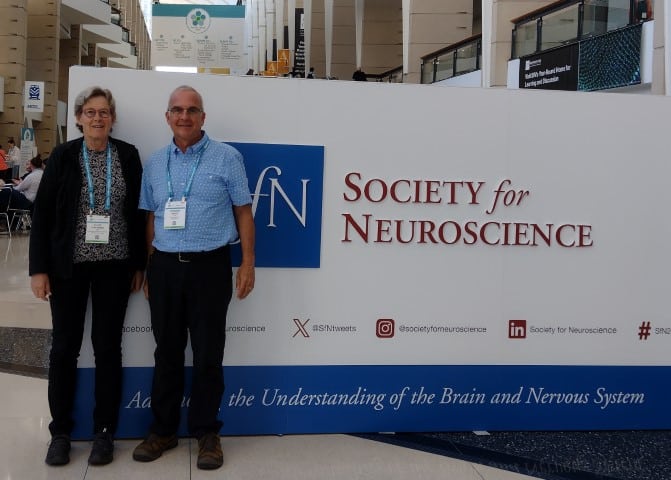
Prof. White and Ellen Vos-Wisse at the meeting
The annual meeting: SfN2024
About 25,000 people attended SfN2024 from October 5th until October 9th 2024 in Chicago. There was a buzzing community in Chicago that at the end of the meeting was replaced by a very active group of runners that were there for the Chicago marathon the weekend after SfN2024.
I was invited by prof. White to attend the annual meeting of the Society for Neuroscience in 2023 (SfN2023). Flying from Netherlands to the United States to attend a conference opens the possibility to add a vacation in the States to the trip.
Before the conference I and my husband Hans had a wonderful trip to the Blue Ridge Mountains and the Great Smoky Mountains. We had a great time. Highlights were: the beautiful fall colours, the Foxfire Museum, the Cumberland Gap, the impressive Appalachian Mountains and the kind and above all the friendly people we met.
The annual meeting SfN2023
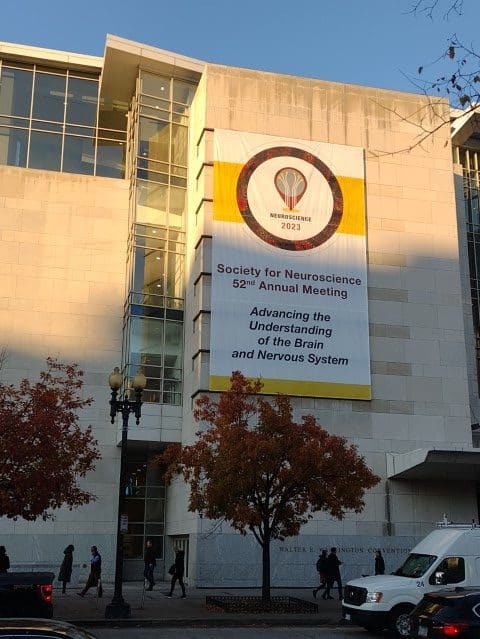
Meeting Venue SfN2023
About 25,000 people attended the meeting from November 11th until November 16th in Washington DC. As a result Hotels are fully booked and so are restaurants. Therefore you have to make reservations well in advance. Attendees were everywhere. For example: Travelling back to the Netherlands in the subway to Dulles airport, a fellow traveller asked Ellen if she had been to the conference (she seemed familiar, which seems peculiar when there are so many visitors). He had been to the meeting, had presented a poster, and was full of it. On the plane to the Netherland there were quite some poster tubes around. Ellen asked two of their carriers to which meeting they had been; it was SfN2023.
Medical Neuroscience starts in 2013. The first time professor White ran the course was in 2013, so our course is celebration its 10th anniversary. As course on the brain, full of valuable information, images and resources Medical Neuroscience has started to inspire many.
Professor White created the course to share the medical neuroscience and clinical neuroanatomy that is taught in most medical schools around the world. Duke University commemorates this achievement in an article in the online news service, Duke Today: “A Decade of Global Reach, From Len White’s Backyard“.
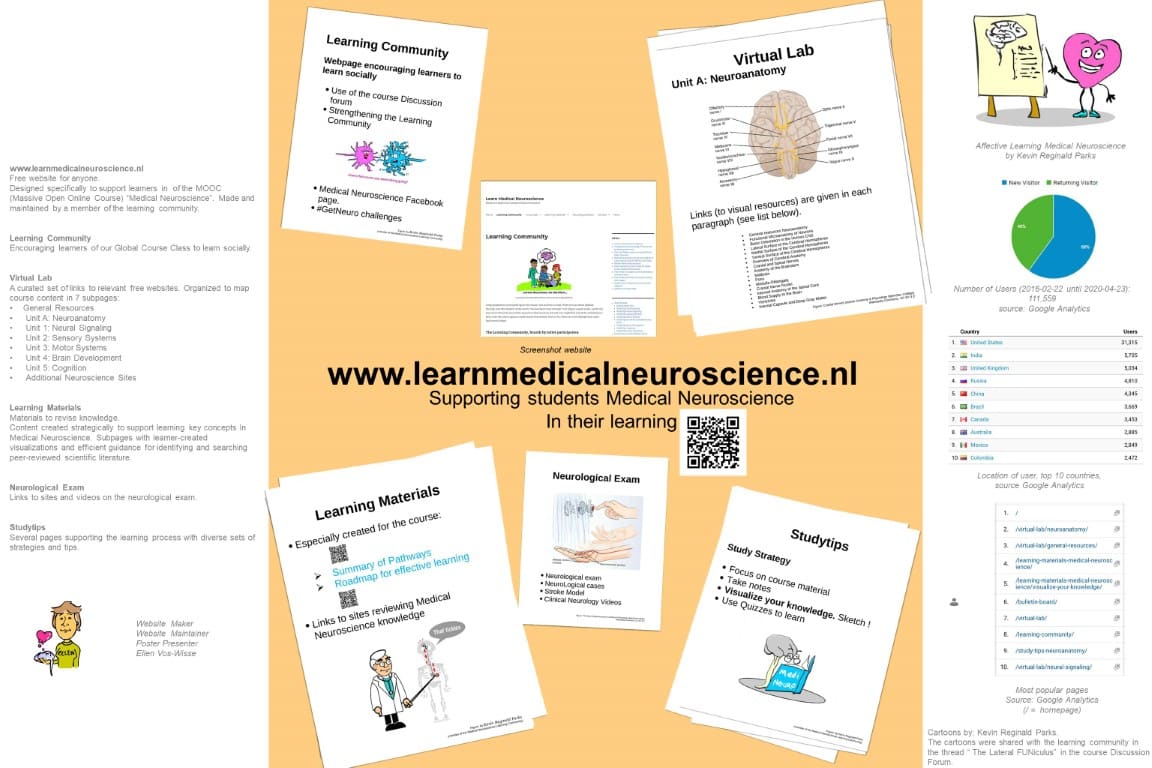
In 2020 we prepared a poster for presentation at SfN2020 in Washington D.C. ( see: Website for distance learning in Neuroscience). We were not able to present the poster as the meeting was canceled due to the developing pandemic of COVID-19.
This time he receives a national teaching award. The national Distinguished Teaching Award by the American Association of Medical Colleges (AAMC), the 2021 Alpha Omega Alpha Robert J. Glaser Distinguished Teacher Award. With this award (only received by 4 individuals each year) the AAMC draws the attention to outstanding contributions to medical education made by gifted teachers (2021 Alpha Omega Alpha Robert J. Glaser Distinguished Teacher Award See their press release
The learning community of our MOOC (Massive Open Online Course) ‘Medical Neuroscience’ really benefits from Prof. White’s educational skills and the effort he takes to facilitate learning neuroscience for students outside the academia. The AAMC recognizes this and on their press release we read:
..” White created and teaches “Medical Neuroscience,” a medical school-caliber online course that has been experienced by over 500,000 learners from more than 190 countries since it began in 2013. The course was named one of the “Top 50 Free Online Courses of All Time” by Class Central….
Prof. White during a hangout session with learners ‘Medical Neuroscience
New Mentor for Medical Neuroscience: Giulia Petitto
by Ellen Vos and prof. White
Our Mentor team has been enriched with a new member: Giulia Petitto. We are delighted to introduce you to Giulia and welcome her to our team.
Prof. White, Giulia and Ellen at a recent Skype meeting
Giulia studies Psychology at Universidad Autónoma de Madrid (online at the moment). As a result of the COVID-19 pandemic she currently resides in Venezuela, where she was raised.
Giulia’s Notebook
Giulia took the course Medical Neuroscience (Coursera) in 2019-2020 . To support her own learning she kept detailed hand-written notes and illustrations (pictured below). She used these notes to study for a neuroscience exam at her current University. She found her notes so useful that she decided to share them with other learners in Medical Neuroscience. Continue reading “New Mentor for Medical Neuroscience”
Tool for distance learning : www.learnmedicalneuroscience.nl
Distance learning is happening all over the world at the moment. Many people are studying neuroscience online, perhaps for the first time. Our website is a valuable tool for learning neuroscience when distance learning during the COVID-19 pandemic. This website was designed to support learning the MOOC Medical Neuroscience. However, it can also serve very well students in many other neuroscience or neurology classes.
Pandemic permitting, we (Ellen and prof. White) are going to present a poster focusing on the website www.learnmedicalneuroscience.nl at the 2020 Annual Meeting of the Society for Neuroscience that is planned in Washington October 24-28.
In this poster we are showing the wealth of resources on the site and the way the website can support distance learning. Below is an early draft of our poster.
Draft poster www.learnmedicalneuroscience.nl for SfN2020